
Why western VCs overlook Eastern Europe: Marcus Erken, Founding Partner of Sunfish Partners, on backing Deep Tech Founders

We’re back with the third edition of our interview series with general partners and limited partners, where we explore the realities of raising and running venture funds today.
Through the WHU ecosystem I had heard Marcus Erken’s name many times before, but I never fully understood why he and his firm Sunfish Partners were so focused on Eastern Europe. The financial logic behind that strategy wasn’t obvious to me, and this conversation finally made it clear. What stood out is how Sunfish not only carved out a niche but also doubled down with their second fund, proving that their thesis on deep tech founders from Eastern Europe has real staying power.
In this edition, we sit down with Dr. Marcus Erken, Founding Partner of Sunfish Partners, to talk about why differentiation matters in venture, what Western VCs often miss about Eastern Europe, and how he sees the ecosystem evolving.
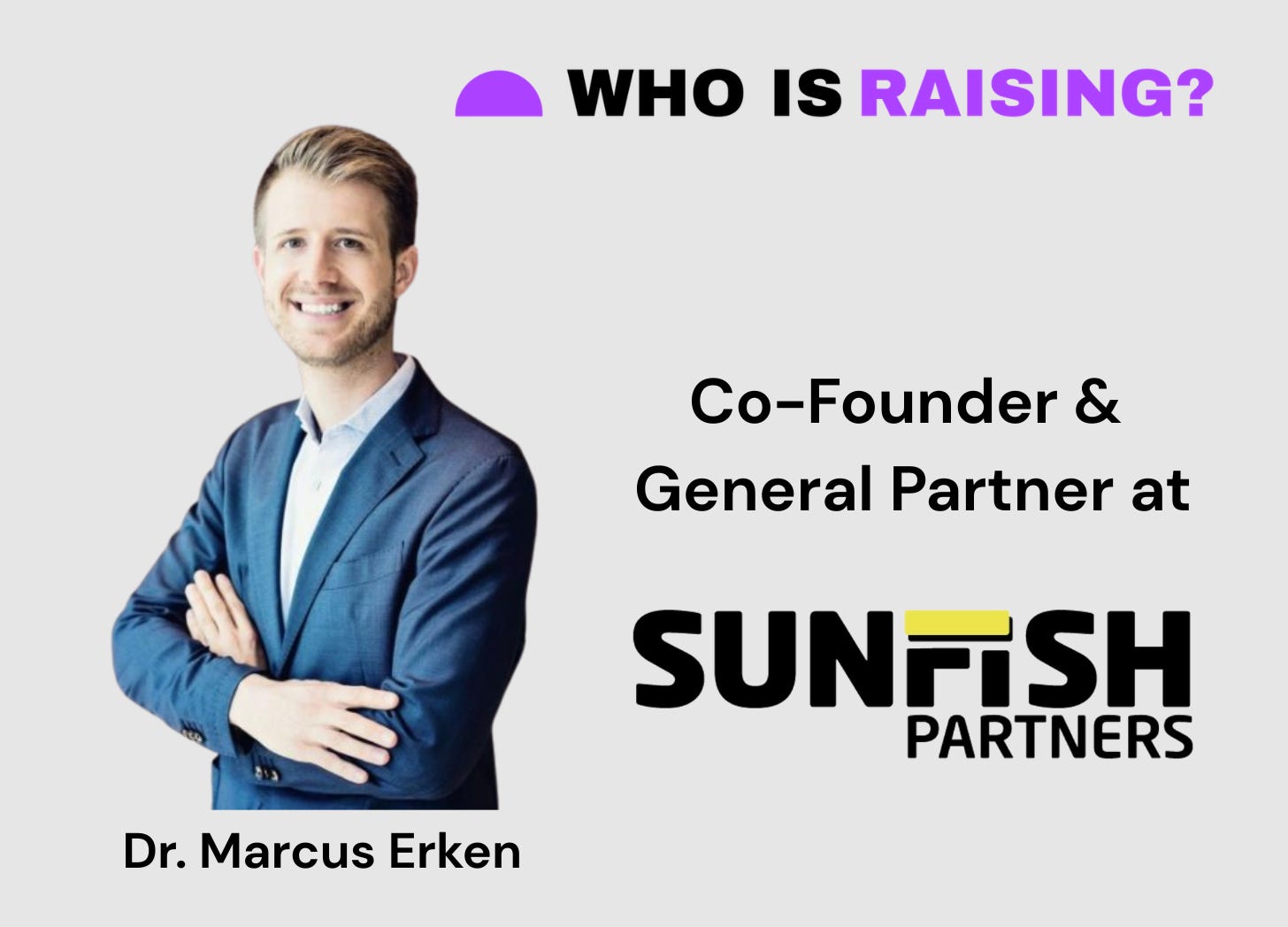
You’ve built Sunfish Partners with a very specific focus. How did that come about and why do you believe this approach works?
We back the best founders from Eastern Europe at pre-seed. Today we’re investing out of our second fund, but my passion for early-stage startups goes much further back. I first fell in love with working alongside ambitious founders in 2013 and have been hooked ever since.
I’ve always been drawn to going deep into niches. To me, the right way to build a fund is to double down on what you’re genuinely good at, what you enjoy doing, and where there’s real market demand. That’s not always easy, it comes with both pros and cons, but for a small early-stage fund like ours, being highly differentiated is a true success driver.
Too often I see VCs pushing their portfolio companies to stand out, while they themselves remain too generic. In my view, there’s no single winning formula in venture capital, but having a crystal-clear sense of what you do, and don’t do, is vital.That’s exactly how we built Sunfish Partners. My co-founder Max and I both asked ourselves the tough questions, combined our answers, and shaped the fund around them.
How did your time at WHU and the incubator there shape your path into venture?
During my PhD with Prof. Malte Brettel, I co-built the WHU Incubator, a completely new concept for the university at the time. Having already completed my bachelor’s and master’s at WHU, I deliberately chose Malte as my supervisor because of his strong entrepreneurial track record and his role as academic director of the Incubator. I positioned myself to take on a leading role there.
In the beginning, resources were almost nonexistent, so the only reason it worked was because so many people poured in enormous amounts of time, heart, and energy. I worked closely with students who wanted to become founders every day, helping them decide whether to launch a company and digging deep into their business models. That hands-on work gave me exposure to a wide variety of ideas and taught me how to support founders.
In parallel, I co-taught the New Venture Creation course at WHU with Malte starting in 2014, and I still volunteer to teach it once a year. It gives me the chance to work with students in their final bachelor semester, right at the moment when many of them are deciding to step into entrepreneurship. That’s still one of the most rewarding things I do.
The advantage of operating in a younger market like Poland, or Eastern Europe more broadly, is that these ecosystems grow disproportionately fast. If you do a good job, you can access almost any deal you want at a fair valuation.
I’d love to hear how Sunfish Partners got started and what led to its creation.
Max Moldenhauer and I started Sunfish Partners in 2016 together with our mutual friend Christian Weiss.
Max had studied at WHU long before me - he’s twelve years older and has been active in the startup scene since the late 90s. Over the years, he co-founded several companies and became an active angel investor. By the time we teamed up, I had just completed my PhD, and Max had been at Project A, where he built their mobile unit. We saw the same opportunity: highly technological founders found it far too difficult to secure funding, even though many of the world’s biggest future challenges will be solved by exactly those types of entrepreneurs. Out of many conversations, our shared conviction to back high-tech founders was born.
When deciding where to start, we looked beyond Germany and became increasingly curious about Poland. We were searching for a market with exceptional technical talent - physicists, mathematicians, medical doctors, data scientists, but with far less venture capital and competition. Our research confirmed the opportunity: VC spend per capita in Poland was dramatically lower than in Germany, let alone the UK or US. It still is in 2025, by the way. Still, we had to test whether we’d be welcomed as outsiders. In 2017 and 2018, we spent countless weeks in Poland, having hundreds of conversations with investors, professors, and founders. The answer was a resounding yes: not only was the funding gap even bigger than we had expected, but people also valued the complementary position we brought, combining our German roots and network with genuine, long-term commitment to the local ecosystem.
We began investing in Poland as angels, and our very first deal, Ramp Network, went on to become one of the country’s most successful startups. At the time, we were their very first angel investors, investing privately because our fund wasn’t yet live. Watching the founders navigate the ups and downs and grow into what Ramp is today has been an incredible experience. We still maintain a very close relationship: we’ve co-invested in multiple companies together, the founders themselves are LPs in our second fund, and we continue to support each other’s journeys.
When you first explored Poland, did you face any language or cultural barriers and how did you make sure you were accepted locally rather than being seen as just another outsider wanting to profit from the growth?
Language was something we considered early on, but it has never been an issue for us. Everything we do is in English, and that’s intentional for two reasons.
First, if a team can’t operate in English, it already signals a form of adverse selection. Our focus is purely B2B in deep tech fields. Unlike in B2C, our founders don’t need deep knowledge of local language, culture, or media to reach customers. What they do need is the ability to engage professional clients in large enterprises, mostly in Western Europe or the United States.
Second, running everything in English from day one makes it easier to hire talent, raise follow-on rounds, and win global customers. Of course, there are moments when having a native Polish speaker is helpful, for example, when dealing with the Polish company register. Our third partner and CFO, Paweł Lipkowski, is Polish, so we have this covered.
What truly matters is understanding the nuances of doing business locally: how employee stock option plans work, how to structure agreements, and how relationships between lawyers and founders typically function. Those are the kinds of insights we’ve made sure to build into how we work.
What are some of the biggest differences you’ve experienced between the venture ecosystem in Eastern Europe and in Western Europe?
One of the biggest differences we’ve seen is the level of trust. In Germany, at the early stage, the default is usually: I trust you until you show me why I shouldn’t*.* That’s not the case in Eastern Europe, where mistrust is omnipresent, between founders, lawyers, VCs and everyone else. We have a couple of theories why that’s the case, and it’s a long discussion. Short story: culture and ecosystem maturity.
The advantage of operating in a younger market like Poland, or Eastern Europe more broadly, is that these ecosystems grow disproportionately fast. If you do a good job, you can access almost any deal you want at a fair valuation. That’s completely different from Germany. Within 15 minutes of my apartment in Berlin, there is more VC capital than in all of Eastern Europe combined—and naturally, far more competition. In Germany, even the best VC has maybe a one-in-three chance of getting into a hot deal, often only by offering higher valuations or more attractive terms to founders, which ultimately hurts returns.
In Eastern Europe, we almost never face that problem. We can secure the deals we want on the terms we need. This comes with trade-offs, of course. We have to hustle much harder and build much of the infrastructure ourselves. When we started, basics like setting up employee stock option plans or flipping a company from Poland to the US were barely documented. We had to figure them out alongside our network and our early portfolio companies.
The upside of working in such an early market is the genuine spirit of collaboration. In Germany, VCs say they collaborate, but with that level of competition it’s mostly marketing. In Poland, there are more great founders than high-quality investors, which makes it possible to work closely with top angels and VCs on joint rounds. My expectation is that within five years, it might be just as competitive there as it is in Germany, but for now, it remains one of the most collaborative environments we’ve seen.
When you started fundraising for your first fund, you were offering something relatively new for Eastern Europe - early-stage capital. How challenging was it to convince LPs, especially those used to investing in markets like Germany, France or the UK, to back a fund focused on this region?
We launched our first fund in spring 2019 and our second in summer 2024. The process has actually stayed surprisingly similar. Back then, “deep tech” was still such an unfamiliar term that our office Wi-Fi password was literally “#deeptech” because I had to explain it to every investor who visited. On top of that, Eastern Europe as an investment focus was considered highly exotic. Today it’s still niche, but far less of an unknown. More investors have started to notice how fast the region is growing, especially in areas like space and defense, where Eastern Europe is disproportionately strong.
The challenge has always been about balance. On one hand, we pitch the huge opportunities in a geography most LPs have no exposure to. On the other, we explain the geo-arbitrage: we invest in pre-seed rounds at Eastern European valuations with low competition, then aim for later rounds in Western Europe and the US at their higher valuations. It’s compelling, but people are naturally cautious with anything new. And venture capital as an asset class is still relatively underdeveloped in Germany, let alone Eastern Europe.
To address that, we combine the upside of Eastern Europe with the familiarity of German structures. Our fund is set up in Germany as a GmbH & Co. KG, BaFin-registered, and built on the same legal framework LPs here are used to. This makes it easier for them to get comfortable. In both funds, most of our investors are highly entrepreneurial individuals—founders, family business owners, and operators—primarily from Germany. Eastern Europe itself still has very few local LPs, as wealthy individuals overwhelmingly prefer real estate investments. The ones who do back us are successful founders or VCs who deeply understand startups.
In our first fund, we had a state-backed LP, PFR from Poland. In our second fund, we are fully private, which gives us more flexibility and less bureaucracy.
What has surprised me most, however, is how often even professional LPs behave in ways that are much more FOMO-driven than you’d expect. Many still follow hype cycles, over-allocating when markets are hot and pulling back strongly during downturns, despite the fact that in a 10+ year asset class, the strongest vintages statistically emerge right after a crisis.
Deep tech often takes even longer than a typical venture case to reach venture-scale returns, which raises the question of whether the classic 10-plus-2-year fund model still fits. Has your thinking on fund structures or timelines changed from your first to your second fund?
We haven’t changed much in terms of fund timelines, but we’ve learned a great deal on both the front end and the back end since our first fund. One of the key advantages of investing so early and at attractive valuations is that even a secondary sale in a large Series A or Series B can already return the fund multiple times. So, while it’s true that deep tech timelines are often very long, as an extremely early-stage fund we don’t need to wait for an IPO or a blockbuster exit to see meaningful returns.
Of course, these earlier liquidity events depend heavily on market conditions and are always case by case. But there are more opportunities for profitable outcomes before the “final” exit than most people assume. That’s why we’re not overly concerned about the long timelines in deep tech.
That’s an interesting point, because for that to work the Series A or B round has to be significant. Based on what you’ve seen, what are typical median valuations for startups in Eastern Europe at those stages?
Our pre-seed rounds take place in Eastern Europe at local valuations, while successful Series A and B rounds typically happen in Western Europe or the US.
Overall, valuations in Eastern Europe are significantly lower than in Western Europe. Across all our pre-seed investments to date (17 from our first fund and 6 so far in our second), the median pre-money valuation has been around €3 million. In most cases, these are teams that have already bootstrapped their startup for six months to several years before we come in. In Germany, comparable teams raise at higher valuations; in the US, comparable teams raise at much higher valuations.
Lower valuations also reflect the reality that it’s much harder for Eastern European teams to gain early traction and recognition from international investors. But that’s exactly where our conviction lies: if we can set up the company properly from day one and position it internationally, it can quickly be taken seriously in Western Europe and the US. The founders we back don’t lack talent or work ethic; they are truly world-class.
When emerging managers come to you for advice on raising their own first fund, what are the most common questions they ask and what guidance do you usually give them?
When someone is just starting out, the first thing I want to understand is their motivation. Launching your own fund can be rewarding, but in the short and medium term it’s usually far less attractive than people imagine. You often need to finance it yourself for years, put in much more than you take out, and shoulder significant personal risk.
I don’t regret starting my own fund. The opposite: It’s my dream job. It allows me to build a VC firm exactly the way I believe it should be. However, it’s a very different reality from working at a large fund with abundant resources. In a small fund your interests are strongly aligned with your LPs, but you also have to endure several tough years before that alignment pays off.
That’s why the key question I ask is whether someone truly wants to be a fund manager. Loving investing is not enough. Running a fund means spending a lot of time on fundraising, compliance, and operations—not just on backing startups. For many talented investors, it might actually make more sense to start out as an angel or join a larger firm, rather than taking on the challenges of building a fund from scratch.
Looking at the European and Eastern European venture market from an LP perspective, what patterns, misconceptions or justified concerns have you noticed over the years from speaking with different funds and investors?
The profiles of LPs are very diverse, so it’s hard to generalize. What has surprised me most, however, is how often even professional LPs behave in ways that are much more FOMO-driven than you’d expect. Many still follow hype cycles, over-allocating when markets are hot and pulling back strongly during downturns, despite the fact that in a 10+ year asset class, the strongest vintages statistically emerge right after a crisis. This cyclical behavior hurts the industry (and LPs’ returns). While today it’s incredibly hard for VCs to raise, I’m certain the pendulum will swing back in a few years.
Another major observation is the structural mismatch between theory and practice. Everyone agrees that small funds have perfectly aligned incentives with LPs, yet most LP programs are designed to back only big funds. This leaves virtually no institutional capital for funds under €30 million (let alone under €10 million), forcing them to rely almost entirely on high-net-worth individuals or small family offices. Ironically, small early-stage funds consistently deliver the best returns, but the system keeps funneling capital almost exclusively to the large players.
As an investor in several VC funds myself, I’ve drawn a personal conclusion: I avoid mid-sized funds altogether. I either back very small, early-stage funds, where returns depend purely on performance, or very large flagship funds, which are more about capital preservation. Mid-sized funds are stuck in the toughest position, competing head-to-head at Series A with giants like Sequoia or Andreessen Horowitz, without the same brand or resources. Exceptions exist, of course.
For the broader ecosystem, this imbalance is a real problem. We desperately need more strong emerging managers willing to bet on the hundreds of new startups that will shape future innovation. Yet the economics make running small funds almost impossible in the short and medium term. In reality, they’re more often subsidized passion projects of managers than sustainable businesses. The industry’s 2/20 fee structure means that large funds have far more money than they need to cover operations, while small ones can only function if their managers underwrite the cost themselves.
So, paradoxically, pre-seed in Europe has to a large extent become a privately subsidized asset class, despite being the stage that consistently generates the strongest returns and creates many of the future jobs and innovations the continent depends on.
Thanks so much for your time and insights, Marcus!
Every week we see new funds joining our platform, which makes this series even more relevant. If you are a fund currently raising or an LP deploying capital, feel free to reach out to us and we will be glad to help. Follow us to stay updated on future interviews and insights from the venture ecosystem.