

We’re back with the sixth edition of our interview series with general partners and limited partners, where we explore the realities of raising and running venture funds today.
Ellipsis Ventures was among the very first funds listed on WhoisRaising, and from the beginning, its story stood out. Founded by Yariv Adan, one of the Co-Founders of Google Assistant, Ellipsis carries the DNA of someone who has spent years at the cutting edge of artificial intelligence. During his 17 years at Google, Yariv helped build some of the company’s most impactful AI products - from Google Assistant to Google Lens giving him a front-row seat to how machine intelligence evolves from research to real-world applications.
In this edition, we sit down with Yariv Adan, Founding General Partner at Ellipsis Ventures, to discuss what defensibility means in the age of AI, how small teams can outpace big tech and what it takes to raise a first-time fund built by product builders.
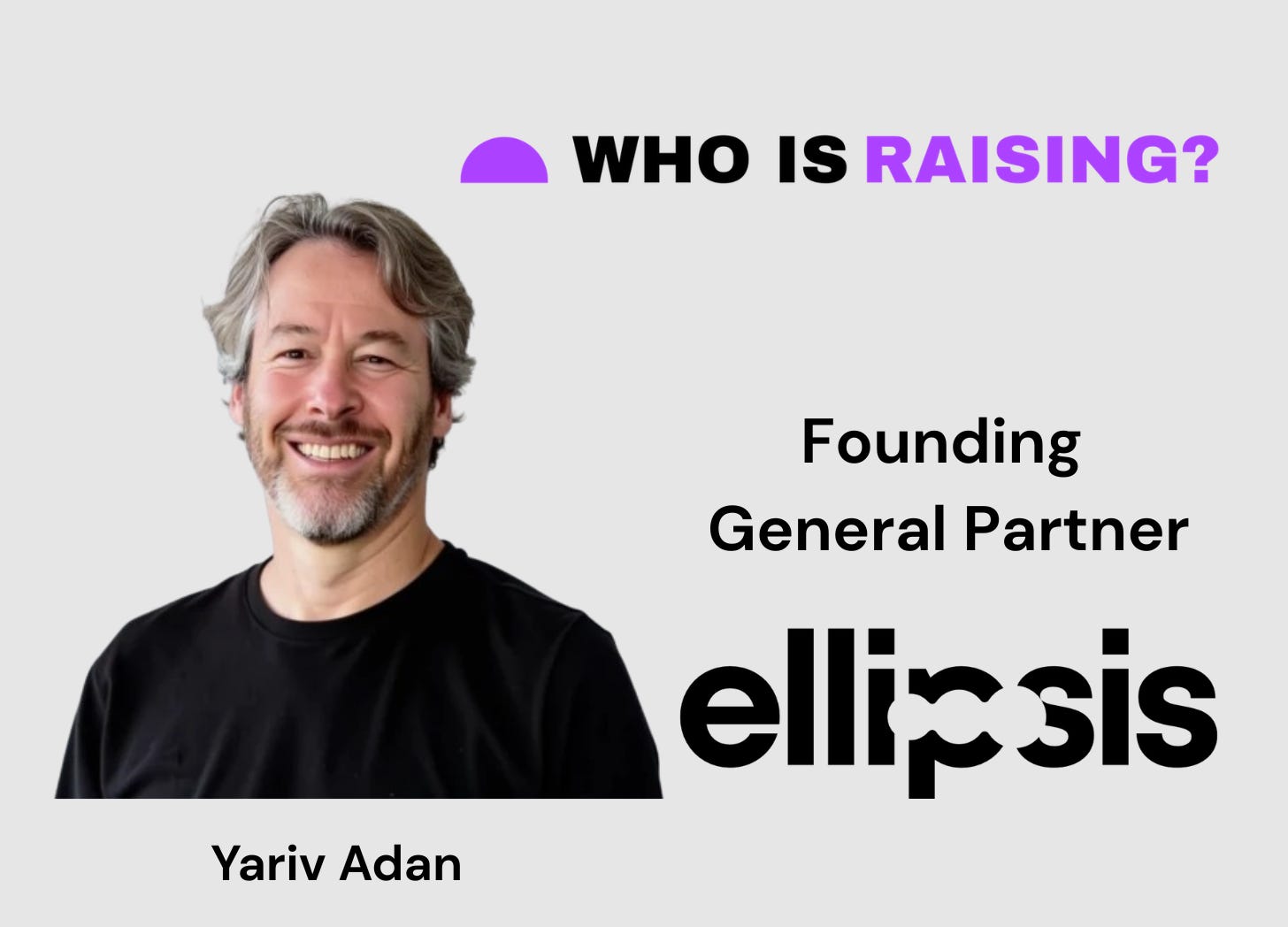
You’ve spent nearly two decades building products at Google before founding Ellipsis Ventures. What’s the story behind that journey from product builder to investor?
I’ve always seen myself first as a product builder who eventually turned into an early stage investor. My journey started back in Israel in the late 90s where I spent about a decade in startups as an engineer and later as an engineering manager. In 2007 I joined Google and moved to Switzerland where I shifted into product roles. Around 2015 I got hooked on AI and together with a few friends we started what became Google Assistant, and later gave it “eyes” with Google Lens. I spent years exploring what it means for AI to be contextual and proactive and later moved to Google Cloud to lead conversational AI. When ChatGPT emerged I led applied GenAI across Cloud AI, helping big enterprises figure out how to use this new wave of technology. After 17 years at Google I decided to take all that experience and start Ellipsis Ventures, a very hands-on early stage fund focused on founders building real AI products. My partners share the same DNA - people who’ve built companies, sold them and spent over a decade at the forefront of AI.
You’ve seen both sides - building AI products at Google and now backing startups. How do you see smaller teams competing with big tech when AI makes product building so much faster and cheaper?
We built Ellipsis as an AI first fund in every sense. From day one we have been automating ourselves using AI for sourcing, reviewing and running our internal operations to stay lean and efficient. Smaller teams do not have endless resources like big tech and yes that means you do not have armies of lawyers, UX researchers or massive budgets but that constraint can actually be an advantage. A focused team that is aligned on product vision, execution and go to market can move much faster than a large organization slowed down by layers of decision making. The real challenge is to make sure that this speed goes in the right direction. I am not worried about startups being able to move fast, what matters is that they build something defensible once big tech enters the space. At Ellipsis we look for companies with clear defensible differentiation that comes from proprietary data or deep domain expertise. If you carve your own path where big tech is not directly competing you are not just faster but also building something they cannot easily copy.
You mentioned defensibility as key. In a world where anyone can access models and scrape data, what does real differentiation in AI look like today?
The bar for differentiation in AI is getting extremely high. In a world where off the shelf 20$ models can write code, and copying a great idea takes a matter of days, writing code is no longer a lasting defensible moat, nor is fast execution and first mover advantage. The way software is bought today will shift toward agentic automation, where brand and trust will matter less over time in favor of automated measurable decisions. For us there are really only two lasting differentiators.
The first is data, meaning data that cannot be scraped or generated. We like problems that require unique access to data such as our investment in a company using reinforcement learning to automate and optimize manufacturing. That kind of data only exists if you install sensors in factories. Another example is a startup designing complex antibodies and proteins where existing datasets are tiny and hard to expand. We look for a flywheel effect where deploying the product generates new data and the model becomes noticeably better within months creating switching costs.
The second differentiator is what I call expertise mode. Most of the new AI stack will be built by big tech but there are still deep pockets of expertise where smaller teams can lead, such as security, optimization, edge computing, identity or payments. We are also looking for what we call neural first components, teams that are building the infrastructure of the future directly for AI rather than adapting old tools. If AI had been invented before databases and APIs they would look completely different, more native to vector space. The startups thinking this way are building something so new that incumbents are not even running in that direction. That is where we see the most defensible opportunities.
How do you and your partners make investment decisions at Ellipsis, and what does your process look like behind the scenes?
We make all our investment decisions together as a team. It forces us to challenge each other and remove bias which I think is a good thing. Back when I was a product manager at Google I used to say that if your own team is not excited to work on what you are building that is a red flag. The same applies to investing. If I cannot convince my partners that this is a great deal then maybe it is not. It is a good check and balances system that keeps us sharp.
We also use AI deeply in our own process. From the moment we receive a deck we run AI tools that analyze the company, team and materials. Within minutes we have a full report. We do not rely on it for the final call but it makes our discussions much more informed. We build a detailed IC report from that first analysis and keep updating it as we speak with founders and collect notes from meetings. By the time we reach the final decision it usually feels straightforward because the process is so structured.
When evaluating a startup we look first at the team - can they build, lead and scale a company and whether they are truly the top 0.1% in their field, knowing there are always many others doing similar things. Then we assess the problem space. We believe the link between value and margins has changed. AI has created what we call commoditized magic. The technology feels magical but the capabilities are becoming utilities like electricity or water. Intelligence will be a utility and unless a company has clear data or expertise modes it will eventually compete on margins. So when we evaluate a problem we always ask whether it allows for defensibility and healthy economics in this new world. Finally we look at the solution and the go to market but those can evolve. Doing this as a team helps us avoid bias and still move fast because we are small, hands on and close to every deal.
You launched a Scout program that works closely with students and researchers. What role does it play in how you source early deals and engage with universities?
The scout program really has two goals. One is to give us access to early stage ideas coming out of universities and the other is to give back. I have four kids myself and I know how hard it is to get that first real opportunity after school. So we wanted to create something that gives students a chance to learn, get hands-on experience and be part of the full investment process. They join our meetings, see how we evaluate companies and if we invest in a deal they brought in they actually get a ticket in it, so it can pay off for them too.
In Europe many great startups come straight out of universities especially from PhD labs. At ETH for example the SRI lab has produced several companies we backed like Logic Star and Invariant Labs. These are very strong technical teams sometimes quite young but with deep domain knowledge. Universities across Europe are producing more and more of this kind of talent. So through our scouts we get early access to these.
Our deal flow also comes from our broader network. After 17 years at Google the alumni network is incredible and we often see founders who are ex-Googlers or connected through that circle. Being originally from Israel we also invest there as the ecosystem is still one of the most dynamic globally. We are active in all the main European hubs, with me in Zurich, Matthias in the Nordics and venture partners in London and other cities. Our deals come from top universities, top tech companies and repeat founders. Around 60% of our portfolio are repeat founders which for me is one of the strongest possible signals.
Your unfortunate motorcycle accident gave you a different perspective on technology and impact. How has that experience shaped what you see as a meaningful business worth backing?
My motorcycle accident pulled me into the world of chronic conditions and changed how I think about technology. At Google Zurich I started a center that showcased tech built to help people with disabilities and that experience got me interested in how technology can support long term health and quality of life. Managing a chronic condition is really about doing things you do not want to do day after day - managing diet, sleep, stress and physical activity. For most people that is about well-being, but for people with chronic conditions it is literally about health. It made me think deeply about how technology can help sustain goals and manage time over a lifetime.
I also learned to appreciate people with “disabilities” or traits that diverge from what’s considered “normal”. In our fast moving world, fixed skills are becoming less important, instead, three other traits prove to be most critical for success, especially as challenges and responsibilities scale: resilience, ability to adapt and self driven motivation.
People with disabilities are top pro athletes in developing and mastering these: resilience, ability to adapt and motivation. We practice, live and breathe these 24/7 every day, all day. I strongly believe that for this reason disability is a superpower, and strongly encourage entrepreneurs and employers to seek out these superheroes.
How has the fundraising journey been for you as a first-time manager building Ellipsis from scratch?
Fundraising is always a challenge but I actually see it as a healthy one. It is another way to test whether your philosophy and investment thesis really resonate with others. We know we have a strong track record as AI operators and a solid record as angel investors, but we also know that we need to prove ourselves as fund managers. That is why when we started we decided not to raise immediately. Instead we invested our own money first. We made more than 12 investments with our own capital, each around 250K, and we warehoused those deals to bring them into the fund at cost even though some already have nice markups. The idea was to prove that we can source strong deals and build a solid process before asking anyone else for money.
Now as emerging managers it is still hard to raise, but having a real portfolio already in place made the first closing much smoother. We are deliberately keeping the fund small at 25 million dollars with around 3 million warehoused from our own side. That is a meaningful GP commitment and shows confidence. We already have some portfolio companies with significant mark-up, and in the next six months we expect more follow-on rounds which should make us even more attractive , and set us up well for a larger second fund. So far things are going well.
I also think fundraising builds empathy. We spend so much time telling founders no that it is good karma to be on the other side for once, pitching, getting ghosted, and feeling what it is like to convince people to believe in you. It is humbling and it makes us better investors. Finally, we were just selected by Slush x Raise as one of the top 20 most promising fund. That’s a great recognition and marketing.
What advice would you give founders building in today’s AI market, where it’s easier than ever to launch but harder than ever to stay defensible?
It has never been easier to start a company, build a prototype and even run a POC with a big enterprise. There is a lot of POC money floating around that looks like revenue but is not tied to real scale or recurring success. Many startups get fooled by that early traction. Speed matters, but only if you are moving in the right direction. Some of our portfolio companies take longer to reach their first revenue, but when they do it is far more defensible.
Founders should ask themselves what right they have to exist with healthy margins three years from now and think about how models are evolving to cover more ground. The key is to build a true defensible moat. Money itself can be a moat, but if you look closely at many startups today they are basically distribution layers for the model providers. The capital flows in but leaves just as fast in API costs and infrastructure fees. That is not a real moat. Brand helps a bit, but in generative AI where new winners appear every week, only a few names like ChatGPT really stick. So the focus has to be on building something that remains defensible long after the hype cycle moves on.
Thanks so much for your time and insights, Yariv!
Every week we see new funds joining our platform, which makes this series even more relevant. If you are a fund currently raising or an LP deploying capital, feel free to reach out to us and we will be glad to help. Follow us to stay updated on future interviews and insights from the venture ecosystem.
It's interesting how you've captured Yariv's journey from product builder to investor; it really highlights unique DNA of someone who's seen AI evolve from the inside, not just from a finance perspective. I'm super curious about what 'defensibility' truly means for a small AI startup when big tech has so many resources – is it mostly about proprietary data or more about novel architectural approaches?